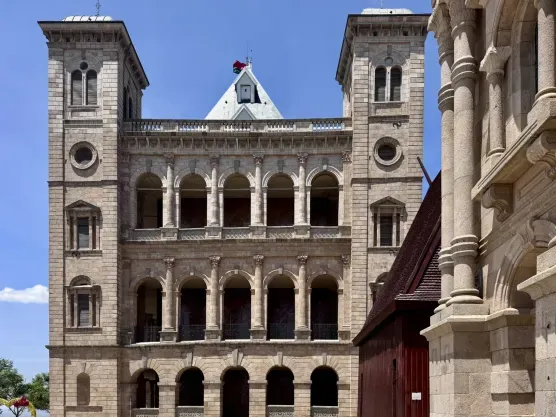
Perched atop the highest hill of Antananarivo, the Queen’s Palace – or Manjakamiadana, literally “where it is pleasant to reign” – is one of Madagascar’s most iconic landmarks.
Visible from nearly every district of the capital, it overlooks the city and recalls both the power of the Merina kingdom and the wounds of Malagasy history.
History
The site of the Rova of Antananarivo (the royal complex of Analamanga Hill) was originally a wooden fortress built by Andrianjaka in the 17th century.
Under Queen Ranavalona I (1828–1861), the Palace of Manjakamiadana took its current form, thanks to Scottish architect James Cameron, who built the stone structure that still stands today.
The palace served as a royal residence, a ceremonial site, a royal tomb, and a political symbol. It also housed the sacred relics of the Merina monarchs.
Key events in its history
The attack by colonizers
In 1895, during the French conquest, the Rova was among the last strongholds of the Merina monarchy.
The colonial troops bombarded the hill, marking the end of the Merina Kingdom and the beginning of French colonization.
The palace remained standing but lost its political role.
The fire of 1995
On the night of November 6, 1995, a devastating fire destroyed most of Manjakamiadana.
The flames consumed almost all of the wooden structure, leaving only the stone walls.
For the Malagasy people, it was as if a part of the nation’s soul had burned away.
Restoration and the Colosseum controversy
Reconstruction took years, delayed by financial constraints and public controversy.
After more than twenty years, the palace regained its grandeur, but the addition of a modern concrete Colosseum inside the complex was heavily criticized as disfiguring the historic site.
Many Malagasy see it as a betrayal of their cultural heritage.
What to see today
Today, the Rova of Manjakamiadana is open to visitors.
You can explore:
- the restored stone walls,
- the royal tombs,
- a museum dedicated to the Merina monarchy,
- and even a dinosaur skeleton collection, surprisingly displayed in one of the buildings.
The area is now carefully maintained and strictly regulated.
Visiting guide
Things to see
- The main Queen’s Palace, restored and open with official guides.
- The Colosseum, for those interested in the modern addition.
- The royal tombs and ritual artifacts.
- The small museum with its fossil and dinosaur skeletons.
- The panoramic view of Antananarivo, one of the best in the city.
Restrictions and taboos
- No photography allowed inside the restored buildings.
- Some areas are sacred (fady) and off-limits without permission.
- Visitors must respect the guides and site rules.
Despite these restrictions, visiting the Rova remains a powerful and symbolic experience, connecting visitors to the heart of Malagasy history.
Practical information
- Location: Analamanga Hill, downtown Antananarivo.
- Opening hours: 8 a.m. to 4 p.m., daily except public holidays.
- Entrance fee: around 10,000–20,000 Ariary (guide required).
- Tip: Visit in the morning to avoid heat and enjoy better city lighting.
How to get there
Summary
The Queen’s Palace of Manjakamiadana is more than just a monument — it is a national symbol, a reminder of both the grandeur and the pain of Madagascar’s history.
Its restored silhouette evokes the nation’s royal past, while the debates over its renovation prove that the Rova still lives in the hearts of Malagasy people.